Woojoo Na

Woojoo Na

A geometer, working across machine learning

I am a mathematician working on machine learning.

Trained in pure mathematics at Oxford, I take structures that already exist in geometry, algebraic geometry and topology, and use them to prove why neural networks and generative models behave the way they do: the right space, the shape of a set of solutions, the geometry of a path.

I am a PhD student in Electrical and Computer Engineering at Northeastern University, advised by Professor Jennifer Dy.

At Oxford, I did undergraduate research with Professor Christophe Petit, Professor Thomas Lukasiewicz, and Dr. Andrey Kormilitzin.

Portrait of Woojoo Na

Research

Geometry and Algebra of Learning

My research answers foundational questions about neural networks and generative models with theorems, built from structures that already exist in geometry, algebraic geometry and topology. Selected papers are listed under each research direction below. A full list is on Google Scholar.

  1. 01Geometry of Optimal Transport
  2. 02Algebraic Geometry of Neural Networks
  3. 03Theory of Mixture-of-Experts Routing
  4. 04Theory of One-Step Generation
Fibers & singularities
Gradient flow on the loss L(a, b) = (ab − c)2 of the smallest network, x ↦ a·b·x. The minimizers form the fiber ab = c of the map (a, b) ↦ ab. As c → 0 the smooth fiber degenerates into two crossing lines, a singular point. Singular learning theory measures such points by the real log canonical threshold.

01Geometry of Optimal Transport

Optimal transport on the space of covariance matrices

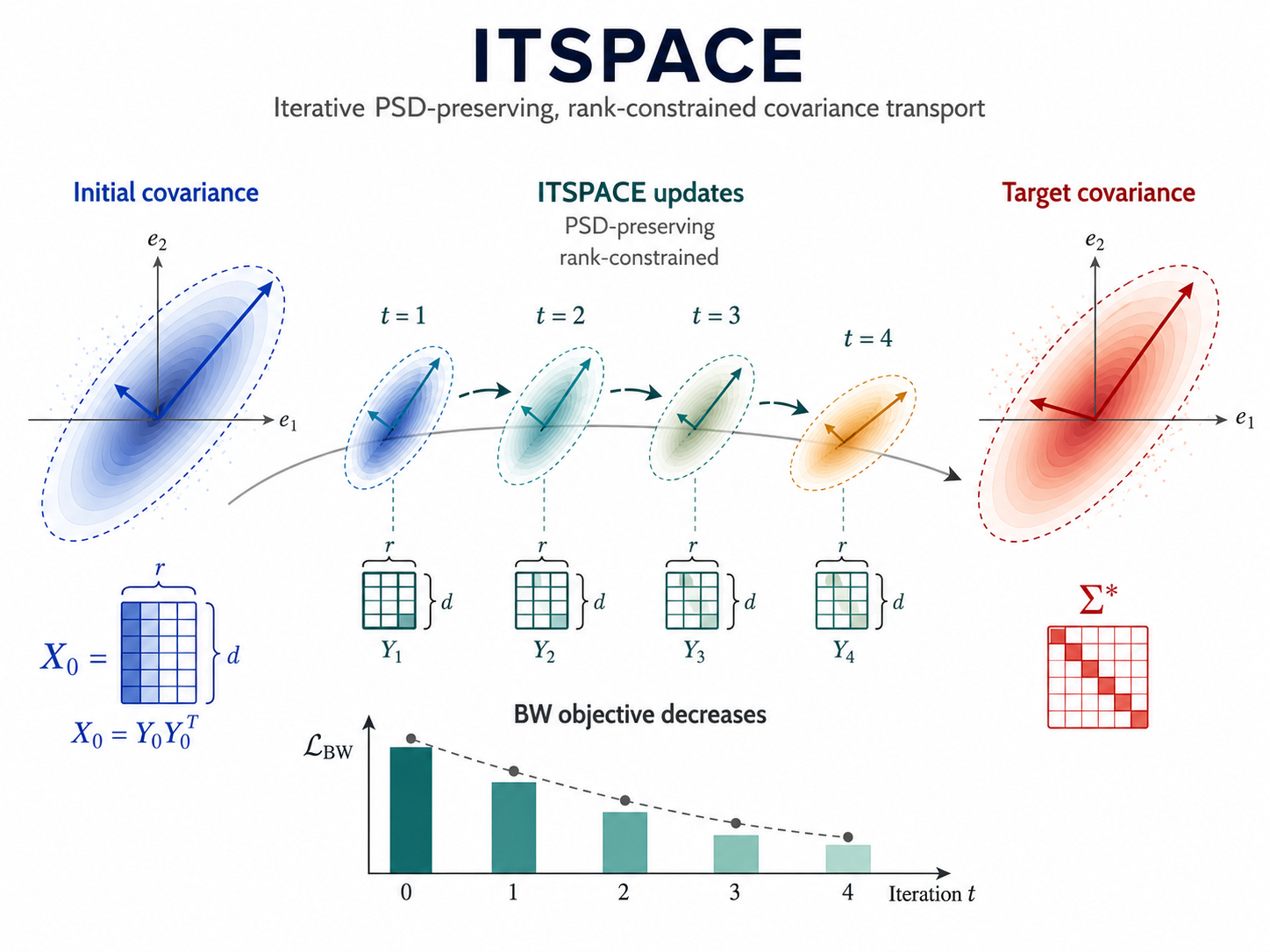
Gaussian distributions with covariances A and B sit in a curved space: the Bures–Wasserstein geometry, where the distance is the optimal transport (W2) cost between them. I design monotone, descent-guaranteed updates on this geometry. In ITSPACE, proximal majorization–minimization on the exact Bures–Wasserstein objective gives closed-form updates in a square-root factorization, with sufficient decrease at every iteration in exact arithmetic and a certificate-gap bound when the polar computations are inexact.

Bures–Wasserstein geodesic Σt = ((1−t)I + tT) A ((1−t)I + tT), with T the optimal transport map from A to B. Straight line (1−t)A + tB, for contrast. Computed live in your browser.

02Algebraic Geometry of Neural Networks

Identifiability of deep polynomial networks

A network whose activations are powers z ↦ zr computes a polynomial, so the map from weights to functions is a polynomial map and the functions it can reach form an algebraic variety. Permuting and rescaling hidden neurons never changes the function. Identifiability asks whether these are the only ways to do so: is each fiber of the map a single symmetry orbit, and if not, how many orbits does it contain? I study these fibers for deep networks with classical algebraic geometry, starting from Waring decompositions, which write a polynomial as a sum of powers of linear forms.

Manuscript in preparation.

The smallest case: two inputs, two hidden neurons with cubic activation, one output. The network computes a binary cubic form (thick curve, drawn in polar coordinates around the dashed zero circle) as a sum of two cubes of linear forms (thin curves). By Sylvester’s theorem a generic binary cubic has exactly one such decomposition, so the weights are determined up to symmetry. As the neurons align (δ → 0) the fiber becomes a curve and identifiability fails.

03Theory of Mixture-of-Experts Routing

Optimal and balanced routing in mixture-of-experts language models

In a mixture-of-experts model, each token's route is a point in a simplex of expert patterns. When is a routing rule optimal, and how can every device stay balanced on every batch without retraining or dropping tokens? I study this in theory, through prices on groups of experts that move tokens between patterns, and on open MoE models with recorded user-conversation traffic.

Manuscript under review.

A toy batch of tokens, each sent to its highest-scoring group. Overloaded groups raise their price, which moves tokens with the smallest score margin elsewhere, until loads meet the target (dashed line). A schematic of price-based balancing, not the paper's algorithm.

04Theory of One-Step Generation

Noise-level design for consistency models

Consistency models learn to jump from pure noise to data in a single step. With a fixed training budget, which noise levels should that budget be spent on? I relate the training noise-level distribution to the averaged loss and to the one-step generator's error, and show why a small loss can still leave a poor generator.

Manuscript under review.

Data x and its noised versions x + σz along the noise schedule. A one-step generator has to undo the whole path at once; the training distribution over σ decides where it learns to do so.

Publications

Earlier work

Undergraduate and early graduate research and projects, kept here for the record.

News

Talks

  • ITSPACE: Monotone Gaussian Optimal Transport Updates Poster, ICML 2026, Seoul · Jul 2026
  • Security of Cayley Hash Functions Invited speaker, Ewha Womans University Cryptography and Mathematics Seminar · Jan 2020
  • Trapdoor attacks on Cayley hash function parameters 17th IMA International Conference on Cryptography and Coding · Dec 2019

Education

  • Ph.D. in Electrical and Computer Engineering Northeastern University · 2024–present
  • B.A. (Hons) in Mathematics University of Oxford, Lady Margaret Hall · 2016–2019